
Less than three months after Prime Minister Narendra Modi proposed the idea, the United Nations General Assembly on Thursday adopted an India-led resolution declaring June 21 as 'International Day of Yoga', recognising that 'Yoga provides a holistic approach to health and well-being'.

Sushma in her address at the Shanghai Cooperation Organisation Council of Foreign Ministers meeting said that terrorism is an enemy of basic human rights.
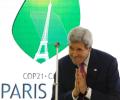
If Paris really meant to serve as a landmark in recognising equity in climate negotiations, it should have heralded the second phase of the Kyoto protocol. Instead we have all countries, India and China included, all signing up with voluntary commitments in what can only be seen as a race to the bottom, reports Darryl D'Monte.

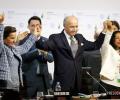
We lost the gains of Rio and Kyoto in Copenhagen and Paris, but it would have been worse, if any mandatory restraints were imposed on our green house gas emissions, says Ambassador T P Sreenivasan.

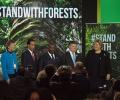
Since the US, the second biggest emitter of greenhouse gases after China, has shifted in a major way to shale gas, the focus of global environmentalists' ire has fallen on India, which is the third biggest emitter, reports Darryl D'Monte.
That does not change with the much-expected new US announcement, it only reiterates the imbalance.

Multilateral platforms are being misused to justify and protect perpetrators of terrorism, External Affairs Minister S Jaishankar said
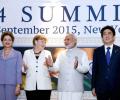
Hosting a summit of leaders of Germany, Japan and Brazil under the G-4 format, the PM said the UNSC "must include the world's largest democracies, major locomotives of the global economy, and voices from all the major continents" to carry "greater credibility and legitimacy".

The two leaders discussed the Ukraine crisis and several regional and global issues including increasing trade relations and cooperation in the field of mitigating the impact of climate change during their bilateral talks at the Danish Prime Minister's official residence in Mareinborg near Copenhagen.

Modi announced a USD 14-million grant for community development projects in the Caricom and another USD 150 million line of credit for solar, renewable energy and climate- change related projects, a statement released by the Ministry of External Affairs said.

Asserting that it has been a strong champion of equity, India on Thursday said developed countries should compensate developing nations for the effects their greenhouse gas emissions have had on climate.

While long term solution depends on each one of us altering our consumption patterns, the future depends on next generation technologists and entrepreneurs creating business models that naturally reduce the green house gas emissions.

'If every city had the strongest tools that are currently available only to a few, the world's climate prospects would glow far more brightly.'

Asserting that there was growing scourge of terrorism in view of fast growing linkages of terrorist groups across the globe, India on Tuesday strongly advocated stepped up cooperation through intelligence exchange and training with 54 African countries.

The Niti Aayog has finalised the first draft of a new national energy policy.

Trump was good for world peace. He didn't start a war anywhere, which is not something that can be said for most of his predecessors, observes Ambassador M K Bhadrakumar.

India believes no country would emerge victorious in the Russia-Ukraine war as all will suffer losses and there will be a "more serious" impact on developing and poor countries, Prime Minister Narendra Modi said on Monday after holding talks with German Chancellor Olaf Scholz as both leaders reiterated the need for an immediate cessation of hostilities.

Johnson will be only the second British leader since Indian independence to attend the annual Republic Day parade in New Delhi as Guest of Honour, after former prime minister John Major in 1993.

Vowing to continue its "strong" response against perpetrators of Paris attack, France on Friday said India was on the "same boat" in fighting terrorism and will cooperate with each other in dealing with the "major" challenge facing the world.

India and Italy inked 15 pacts and finalised an ambitious action plan to further expand their ties following a virtual summit between Prime Minister Narendra Modi and his Italian counterpart Giuseppe Conte that primarily focused on ramping up economic engagement.

"Have just got the good news that due to the hard work of our teams and your cooperation, a consensus has been reached on New Delhi G20 Leaders Summit Declaration," Modi said while addressing the second session of the Summit at the Bharat Mandapam in New Delhi.

The two countries also decided to expand trade and commercial ties holding that there are opportunities to exploit untapped economic potential in the two countries.

Emphasising that various issues are on agenda at the G20 under India's leadership.

Opportunity for India to take leadership in economic diplomacy.

The French president said that peace should be maintained in the region and peoples' rights should be protected.

So far the coronavirus, which originated in the Chinese city of Wuhan, has infected more than 54 million people around the world and killed over 1.3 million others.
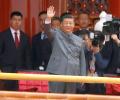
'India finds itself in an unenviable situation today with its prospects diminished by acutely polarised domestic politics and the setbacks suffered during the pandemic,' notes Ambassador Shyam Saran, the former foreign secretary.

'It is in the interest of both sides that the visit of the US President is seen as being successful. Both sides have invested considerable political capital in it. This rapid exchange of visits and the decisions taken have to be justified, beyond the symbolism, which is no doubt important in itself. This opportunity to impart a fresh momentum to ties should not be missed,' says former foreign secretary Kanwal Sibal.

The Indian High Commission made its displeasure known despite the British government earlier reiterating that the three New Delhi laws on agricultural reform were a "domestic matter".

All the three issues raised by China at the Modi-Xi meeting are either intractable or peripheral to the bilateral relations and suggest conventional methods to placate the other side without yielding much, says Srikanth Kondapalli.

'Keeping Kashmir out of the informal summit does not mean that they have given up their strategic interest.'
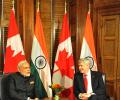
Canada will supply uranium to energy-starved India beginning this year over a period of five years, a decision which was termed as a launch of a new era of bilateral cooperation and mutual trust by Prime Minister Narendra Modi.

'We are completely engaged in fighting poverty; alas, our neighbour Pakistan seems only engaged in fighting us.'

A glance back at some important events that occurred in 2018.

The strategic pacts were inked after the summit between Prime Minister Narendra Modi and his Japanese counterpart Shinzo Abe during which they also discussed international and regional issues of mutual importance including UN security reforms.

India and China on Friday agreed to seek a "political" solution to the border dispute at the earliest as Prime Minister Narendra Modi asked Beijing to "reconsider its approach on some issues" and announced CBMs like e-visa for Chinese tourists and operationalisation of hotline between two militaries.

Even as the United States snuggles closer to India with the thinly veiled objective of containing China, the Indian strategy is to avoid alienating either nation.

This is the joint statement issued by the ministry of external affairs on the visit of US President Barack Obama to India.
